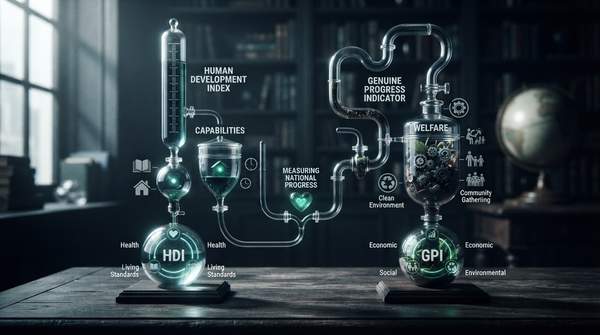
For decades, Gross Domestic Product (GDP) has been the primary yardstick for a nation's success, but its focus on economic output alone misses crucial aspects of well-being. In response, alternative metrics have been developed to provide a more holistic view of national progress. Among the most prominent are the Human Development Index (HDI) and the Genuine Progress Indicator (GPI). While both seek to look beyond raw economic growth, they do so in fundamentally different ways. The HDI assesses a country's achievements in human capabilities like health and education, whereas the GPI adjusts economic activity to account for social and environmental costs and benefits.
The Human Development Index (HDI): A Focus on Capabilities
The United Nations created the Human Development Index to shift the focus of development economics from national income to people-centric policies. According to the United Nations Development Programme, the core principle of the HDI is that "people and their capabilities should be the ultimate criteria for assessing the development of a country, not economic growth alone." It provides a summary measure of a country's average achievement in three key areas of human development.
The HDI is built on three distinct dimensions. The first is a long and healthy life, which is measured by life expectancy at birth. The second dimension is knowledge, assessed through a combination of the average years of schooling for adults aged 25 and older and the expected years of schooling for children entering school. The third dimension is a decent standard of living, which is measured by Gross National Income (GNI) per capita. The index uses a logarithm for income to reflect the idea that as income increases, its importance to human development diminishes. These three dimensions are then combined into a single composite index, allowing for a broader comparison of development than GNI alone.
The Genuine Progress Indicator (GPI): Adjusting for True Welfare
The Genuine Progress Indicator (GPI) offers a different approach by directly confronting the shortcomings of GDP as a measure of welfare. The GPI is designed to measure a country's well-being by considering the trade-offs between economic, environmental, and social factors. It starts with personal consumption data, similar to what is used in GDP calculations, but then makes a series of crucial adjustments. It is intended to reflect whether economic growth is actually beneficial when accounting for its wider impacts.
The GPI framework subtracts factors that represent social and environmental costs. These deductions can include the costs of pollution, resource depletion, and crime. For example, an oil spill might increase GDP through cleanup spending, but the GPI would subtract the environmental damage. Conversely, the GPI adds value for contributions not captured in market transactions, such as volunteer work and unpaid household labor. This methodology means that a rising GDP could occur alongside a stagnant or falling GPI if the economic growth comes at the expense of environmental health or social cohesion. Several U.S. states, including Maryland and Vermont, have implemented a Genuine Progress Indicator to guide policy.