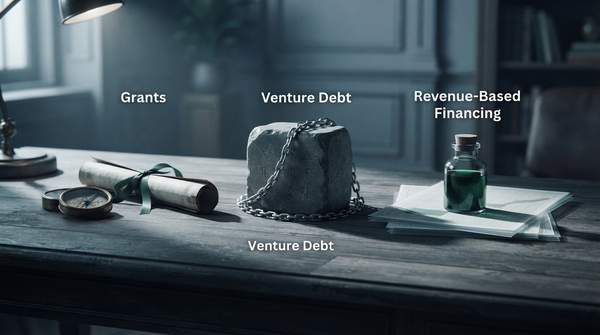
Deep tech startups do not follow the familiar seed-to-Series-A-to-exit script. Because they emerge from scientific research and can spend years on prototyping, testing, certification, and industrial development before earning their first euro of revenue, they need a deliberate sequence of capital: non-dilutive grants and public funding early, specialized venture capital later. Founders who match the funding source to the stage survive the journey; those who chase the wrong investor at the wrong moment often stall in the gap known as the "valley of death."
The Unique Journey of Deep Tech: From Lab to Market
The defining feature of deep tech is time. A software company may launch quickly and generate early revenue, but businesses developing new battery chemistries, quantum computing systems, advanced semiconductors, medical devices, or novel manufacturing processes face long development cycles and high capital intensity before reaching the market, as early-stage investing analysis by LenderKit's Philip Volna explains. That makes evaluating a deep tech company more complex than evaluating a typical startup.
Conventional venture funds are usually structured around a ten-year horizon, which does not always align with deep tech's longer development cycles, so the standard funding progression seldom applies cleanly, according to Oracle NetSuite's guide to deep tech startups. Many founders therefore rely on non-dilutive funding early on, and government support plays an outsized role: federal grant programs such as the NSF's SBIR awards, R&D tax credits, regulatory pathways that speed market access, and public procurement in which government agencies act as early customers. Specialized deep tech venture funds have grown alongside this ecosystem, with the sector's share of all global VC having doubled since 2019.
A bachelor's thesis from LUT University in Finland, combining a literature review with interviews of founders and VC investors, frames the central difficulty: because deep tech innovations often originate in academic research, bridging the gap between research and market viability remains a critical challenge—commonly known as the valley of death. The framework below organizes that journey into stages and maps each to the capital that fits.
Deep Tech Commercialization: Stages, Funding, and Challenges
Use this table as a strategic roadmap: identify where the venture stands, confirm the funding type that matches that stage, and anticipate the challenge that defines it. The stages are a general model; individual company journeys may vary.
| Commercialization Stage | Primary Goal / Milestone | Typical Funding Sources | Key Challenges |
|---|---|---|---|
| Foundational research | Prove core scientific or technical feasibility; establish a strong research foundation, often without a clear commercialization path | Public research-to-business (R2B) grants, university-affiliated funds and programs, federal grant programs such as NSF SBIR awards | High R&D costs; business model typically undeveloped; success measured by scientific validation, not market readiness |
| Pre-commercialization ("valley of death") | Bridge the gap between scientific proof-of-concept and market readiness | Non-dilutive grants and public funding; early-stage specialized investors who understand long timelines and technical risk | Initial research funding runs out before the technology is mature enough for significant private investment |
| Early commercialization and growth | Achieve specific technical and scientific milestones—R&D, prototyping, testing—before a viable product exists | Patient, specialized venture capital, often released against milestone-based structures; follow-on financing as the company progresses | High capital intensity; investors must distinguish technical failure from normal development risk |
| Market scaling | Reach the market and grow, with government agencies sometimes acting as early customers | Later-stage specialized VC and industrial partners; public procurement and regulatory pathways can accelerate access | Long development cycles can outlast conventional fund horizons; continuity of investment across stages |
Stage 1: Foundational Research and Concept Validation
Deep tech typically begins in a university or government lab, where the goal is scientific discovery and proof of technical feasibility rather than market readiness. At this point there is often no clear commercialization path, and the business model is undeveloped. The right capital here is patient and non-dilutive: public R2B grants, university-affiliated resources, and programs like VentureWell give founders time for the technology to mature before taking on equity investment, as NetSuite's guide notes.
Finland's R2B model, studied in the LUT thesis, illustrates how structured public programs support this transition, providing early-stage commercialization support for public research organizations. The thesis identifies venture capital as a primary enabler for post-R2B growth, playing a dual role in financing and strategic guidance—but only after the public funding has done its work.
Stage 2: Navigating the 'Valley of Death' – Pre-Commercialization
The valley of death is the point where initial research funding is exhausted while the technology is not yet mature enough to attract significant private investment. This phase is characterized by the specific challenge of bridging scientific proof-of-concept and commercial viability, and it is where many deep tech ventures fail for financing reasons rather than scientific ones.
The practical answer is sequencing rather than choosing. An advisor with sixteen years of experience guiding European technology companies on innovation funding, writing in The Recursive, argues that founders who ask "grant or venture capital?" frame the question incorrectly—public funding and VC are better understood as stages that prepare a company for each other. Non-dilutive grants carry the venture across the gap, and specialized early-stage investors who understand technical risk pick up the baton once milestones are within reach.
Stage 3: Early Commercialization and Product Development
Once a venture enters active R&D, prototyping, and testing, capital needs escalate sharply. Success at this stage is measured by technical progress, not revenue. Deep tech investors must be comfortable structuring capital around scientific or technical milestones rather than the growth metrics that drive software investing, NetSuite's guide emphasizes—this is milestone-based funding in practice.
Specialized deep tech VC funds are often the most obvious source of institutional capital here, investing at pre-seed, seed, or later stages and providing follow-on financing as the company progresses, according to Volna's analysis. Crucially, a specialized fund can understand the difference between technical failure and normal development risk—a distinction a generalist investor may not draw. Dedicated funds also bring more than money: their networks may provide access to technical experts, later-stage investors, industrial partners, and potential customers.
Selecting the Right Partners: Evaluating Deep Tech Investors
Just as investors scrutinize deep tech founders, founders benefit from evaluating potential investors with equal care—the wrong investor relationship can cost a deep tech startup more than a bad funding round, NetSuite's guide warns. The first question to ask before accepting capital is whether the investor understands milestone-based funding and can structure capital around scientific or technical milestones.
The World Bank Group's IFC, in its publication on financing deep tech, identifies a structural weakness on the investor side: private investors are often not familiar with the milestones and challenges that deep tech entrepreneurs face at different stages of their growth and commercialization journey. The IFC also notes that investors may need to better understand more formal IP valuation, and that metrics customized for each vertical—yet recognized across industries—would facilitate continuity of investment. A founder should probe exactly these gaps.
Practical vetting questions follow from the evidence: Can the fund distinguish technical failure from normal development risk? Does its network include technical experts, industrial partners, and potential customers? Is it structured to tolerate development cycles longer than a conventional ten-year fund horizon? Does its diligence process include genuine scientific review and patent assessment rather than only growth-metric analysis?
Strategic Investor Selection for Deep Tech Success
Founders should prioritize investors who demonstrate a clear understanding of milestone-based funding, patience for long development cycles, and the ability to provide technical and network support, rather than focusing solely on the amount of capital offered. The evidence is consistent on this point: generalist capital structured around software-style growth metrics is poorly matched to ventures whose value accrues through scientific milestones and intellectual property.
A founder has successfully selected an investor if the investor's due diligence includes scientific review and patent assessment, and they offer ongoing technical or strategic guidance. That is the measurable test to apply before signing a term sheet—and the same test an investor evaluating a deep tech opportunity should be able to pass.
Sources
- Early-Stage Deep Tech Investing: How to Fund Companies Before Commercialization — LenderKit
- What Is a Deep Tech Startup? — Oracle NetSuite
- LUTPUB
- European Deep Tech Funding: How to Sequence Grants and VC — The Recursive
- Documents1