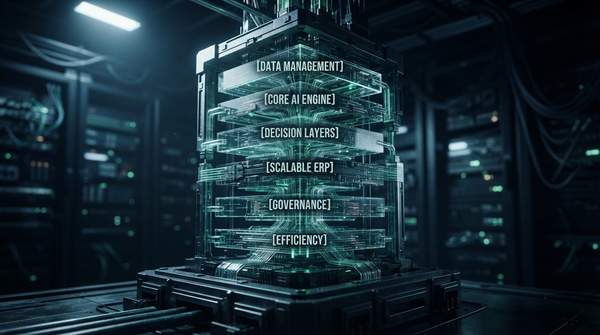
Artificial intelligence is reshaping enterprise resource planning, but the gains in operational efficiency and decision-making do not come from simply buying AI features. They come from how those features are architected into the ERP estate. AI in ERP means integrating technologies such as machine learning, natural language processing and predictive analytics into ERP systems to automate routine tasks, improve forecasting and support faster, data-driven decisions, as IBM's explainer on the subject defines it.
The strategic risk is architectural. Many organizations introduce AI capabilities into ERP systems without redesigning the underlying architecture, which tends to produce isolated use cases that do not scale across the enterprise, according to analysis published on ERP Software Blog. A structured AI enterprise architecture, by contrast, is credited with delivering consistency across systems, scalability for future automation, clear separation of responsibilities and better governance and control. That distinction—between scattered automation and a unified, layered framework—is the decision boundary technology leaders face.
Introduction: The Reshaping Power of AI in ERP
ERP platforms have historically been static, on-premises systems of record. Monu Sharma's paper on AI integration in ERP, published on arXiv in November 2025, characterizes the current transition as a move toward systems that can adapt and operate in cloud-native architectures. That shift matters because it changes where intelligence can live: AI services can be deployed as a distinct architectural tier that consumes ERP data, rather than as code embedded in each module.
Vendor implementations show what this looks like in practice. Oracle's documentation for its OCI Generative AI ERP integration describes AstuteAP, an AI-driven accounts payable automation solution that connects to customer ERP systems—supported platforms include PeopleSoft, Oracle E-Business Suite, JD Edwards EnterpriseOne and Ellucian Banner—to eliminate manual data entry, reduce errors and accelerate the accounts payable workflow. The solution sits alongside the customer's ERP and communicates through an integration layer, a pattern that generalizes beyond accounts payable to any AI-augmented ERP function.
For a technology leader, the practical question is not which AI features exist but where each capability belongs in the stack and what the architecture must guarantee for it to deliver value reliably. The four-layer model below provides that vocabulary for planning and vendor evaluation.
AI-ERP Architectural Model: Layers and Functions
The model below deconstructs an AI-integrated ERP system into four generalized layers, assigning each its function, the AI capabilities it typically hosts, and representative business applications. It is a synthesis drawn from industry analysis and vendor documentation, not a single universally defined standard, and vendors' implementations may merge or split these tiers.
| Layer | Function | Key AI Capabilities | Business Application |
|---|---|---|---|
| Data & ERP Core Layer | Foundational repository for all enterprise data and core ERP functionality; the base for AI integration and data processing. | AI-powered data extraction and validation against known patterns; machine learning that improves over time from processed records. | Accounts payable invoice processing: recognizing varied invoice formats and languages, extracting key information, flagging discrepancies. |
| AI Services & Model Layer | Hosts AI models and services that process ERP data to generate insights and automate tasks; where AI logic resides and operates. | Predictive analytics, natural language processing, machine learning, generative AI for content creation and scenario planning. | Forecasting consumer behavior and market dynamics from past behaviors; drafting messages; generating evaluated business scenarios. |
| Integration & API Layer | Facilitates seamless communication between the ERP core, AI services and external applications; ensures interoperability and efficient data flow. | API-first design, pre-built connectors, gateways and secure network paths (internet gateway, site-to-site VPN, encryption in transit). | Connecting an AP automation service to multiple ERP platforms without custom interfaces for each. |
| User Interface & Application Layer | User-facing applications and interfaces where AI-driven insights and automations are presented and acted on. | Contextually relevant NLP interactions; generative outputs such as drafted communications, code or documentation. | Presenting AI-generated scenario recommendations and personalized messages to end users for decision and action. |
Reading the model from bottom to top mirrors the path of a single transaction: ERP data and documents enter at the core, AI services interpret and act on them, the integration layer moves the results between systems securely, and users encounter the outcome as insight or automation in an application. Each layer has a distinct responsibility, which is what makes the separation valuable for governance and for scaling.
Key AI Capabilities Across the Architecture
The capabilities in the model are not interchangeable, and placing them correctly is what turns a feature list into a functioning system. Predictive analytics lives in the AI services layer, where ERP systems infused with AI tools use past behaviors and organization-specific inputs to predict consumer behavior or market dynamics, allowing leaders to make data-driven decisions quickly.
Natural language processing spans two layers. As a service capability, it lets an ERP system understand and respond to human language; IBM notes that newer large language model technologies have significantly improved the discipline, enabling more nuanced and contextually relevant NLP tools within ERP software. At the interface layer, that same capability becomes the interaction model users actually experience.
Generative AI contributes two distinct functions. For content creation, it can draft emails, marketing content, code or technical documentation based on predefined parameters, with applications ranging from personalized messages to individual consumers or employees to translating code between languages. For scenario planning, AI generates various business scenarios and evaluates potential outcomes—an advance IBM illustrates with an AI-enabled ERP system that analyzes sustainability regulations and produces customized recommendations to reduce an organization's carbon footprint.
At the core data layer, the pattern is different and less glamorous. In Oracle's AstuteAP example, OCI Generative AI recognizes and interprets various invoice formats and languages, machine learning algorithms identify and extract key information with high accuracy, and validation compares extracted data against known patterns to flag discrepancies and potential errors. Continuous learning means the system improves over time from processed invoices. This layer is where data quality—and therefore everything above it—is won or lost.
Strategic Benefits of a Structured AI-ERP Implementation
The business case for architectural discipline is concrete. ERP Software Blog's analysis of a structured ERP AI framework identifies five benefits organizations can achieve: scalability, because a modular architecture lets AI capabilities expand without disrupting existing systems; flexibility, because components can be updated or replaced as technology evolves; improved efficiency, through automated workflows that reduce manual effort and speed processes; better decision-making, from AI-driven insights supporting more informed operational choices; and stronger governance, through integrated controls that ensure compliance and accountability.
Oracle's implementation shows these benefits expressed measurably at the workflow level: reduced invoice processing costs, accelerated cycle times, minimized errors, scaling to handle varying invoice volumes, real-time tracking and reporting on invoice status, and auditable records of all processing activities. Those are exactly the categories a technology leader should demand from any AI-ERP proposal—operational cost, speed, accuracy, scalability, visibility and compliance—rather than generic claims of intelligence.
Two caveats keep the evaluation honest. First, the capabilities described here are drawn from specific vendor contexts, and may not represent all implementations. Second, the framework's value depends on genuine separation of responsibilities: an architecture that works for one isolated use case but cannot extend across the enterprise is the failure mode the structured approach exists to prevent.
Strategic Imperatives for AI-ERP Integration
Technology leaders should prioritize a structured, layered architectural approach when integrating AI into ERP systems to maximize scalability, efficiency, and governance. In practice, that means evaluating any AI-ERP initiative against the four-layer model: asking where the data and AI services will live, how integration and API connectivity will be secured, and what users will actually see and be able to act on. It also means resisting vendor narratives that sell intelligence without an integration story.
The commitment is checkable. Successful integration will be observable through improved operational metrics, such as reduced processing costs and enhanced real-time reporting capabilities, alongside increased user adoption of AI-powered features. Organizations that cannot point to movement on those measures within their implemented scope have features, not an architecture—and the five-benefit framework above provides the terms for holding the next vendor conversation, and the next phase of the roadmap, to account.
Sources
- Artificial Intelligence in ERP — IBM
- Agentic ERP Architecture: Designing ERP AI framework — ERP Software Blog
- AI Integration In ERP Evaluation Across Trends and Architectures — arXiv.org
- Integrate ERPs with Oracle Cloud Infrastructure Generative AI — Oracle Help Center