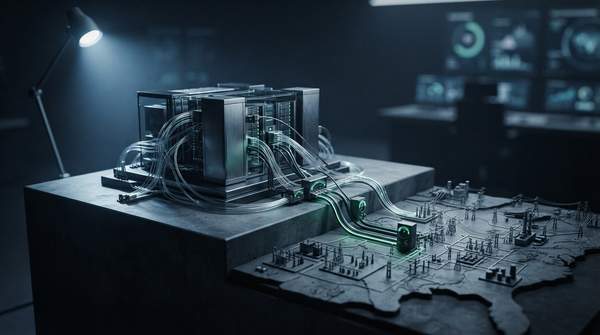
The rapid, large-scale, and highly variable electricity demand of AI data centers is forcing a strategic shift in how technology companies build and run computing infrastructure. Expert analysis from the Belfer Center, Penn State's Institute of Energy and the Environment, and energy policy researchers converges on one conclusion: a singular focus on cheap power is no longer sufficient. Developers and investors now must treat grid reliability, regulatory design, and operational flexibility as inseparable parts of site selection and project finance.
The New Grid Reality for Data Centers
Unlike traditional industrial customers, AI data centers create highly variable demand patterns. Penn State's Institute of Energy and the Environment explains that during large-scale model training, power use may rise and fall rapidly as computing tasks change. How much of that variation reaches the grid depends on facility design—whether the site uses energy storage, on-site generation, or systems that smooth those swings.
The physical mismatch matters. Many large power plants and grid components were engineered to run steadily, not to repeatedly ramp output up and down. Greater uncertainty and volatility complicate planning, increase operating costs, and can require new infrastructure. Penn State's analysts are careful not to overstate the threat: this does not mean every data center risks causing a blackout. It does mean large AI facilities must be modeled and operated as significant parts of the power system rather than ordinary commercial customers.
The Belfer Center's research team documented how quickly theory becomes practice. In July 2024, a voltage fluctuation in northern Virginia triggered the simultaneous disconnection of 60 data centers, producing a 1,500-megawatt power surplus and forcing emergency adjustments to prevent cascading outages. The episode also exposed the financial stakes: if anticipated demand fails to materialize, utilities—and their consumers—could face stranded costs from massive generation and transmission investments.
Strategic Framework: Mapping Grid Risks to Data Center Decisions
The practical question for executives and investors is how to translate these risks into decisions. The framework below synthesizes the evidence into a planning tool: identify the dominant grid risks in a target region, then match them to site selection criteria and operational models that mitigate them. Two risk categories are well supported across the sources—reliability and volatility, and regulatory design.
Strategic Decision Framework for Data Center Development
| Grid Risk Type | Implication for Data Centers | Strategic Response (Site Selection) | Strategic Response (Operations) |
|---|---|---|---|
| Reliability & Volatility | Unprecedented scale and dynamic AI workloads create uncertainty that complicates planning and raises operating costs; voltage fluctuations can trigger simultaneous disconnections, as northern Virginia's July 2024 event showed, producing power surpluses and emergency grid adjustments. | Prioritize sites with robust grid infrastructure or potential for significant on-site generation and storage, modeling grid-only, hybrid, and fully onsite configurations. | Implement on-site demand management, battery storage, and flexible workload shifting—strategies that make data centers part of the grid solution rather than solely a burden. |
| Regulatory Design | Market rules governing dispatch, pricing, and compensation can change; the Kleinman Center for Energy Policy notes that when new mechanisms interact poorly with system conditions, they can distort incentives or undermine reliability. | Favor jurisdictions where policy clarity on cost responsibility and clean energy integration reduces long-term rule-change exposure. | Build operational flexibility—demand response capability and clean-energy alignment—that positions the facility favorably under emerging incentive structures. |
The framework's logic is straightforward: reliability risk is fundamentally about matching volatile demand to a grid built for steadiness, while regulatory risk is about policy choices that can shift costs onto—or away from—large loads. Each response column addresses one side of that ledger. Bloom Energy's site-selection analysis captures the siting principle well: the "best" site is not necessarily the one with the lowest upfront cost, but the one that can deliver power at the required scale within the required timeframe, accounting for the financial impact of delays and long-term scalability.
Evolving Operational Models for Grid Resilience
Operational strategy is where the biggest change is occurring. Penn State frames the core choice starkly: should large computing facilities be required to better manage their demand—smoothing spikes through energy storage or on-site generation—or should utilities invest in new infrastructure to meet the new loads? In practice, its analysts conclude, successful integration will probably require both.
Geographical load shifting is the most striking emerging model. NRDC highlights a 2025 Duke University study in which researchers found that a facility could briefly stop or shift operations to data centers in other regions when overall demand peaks. If adopted widely, the study estimated, this practice could allow the United States to accommodate 100 gigawatts' worth of data center growth without additional power generation or infrastructure. Some states and utilities are already moving to require more flexibility from large-load customers to get ahead of potential impacts on residents, from blackouts to higher electric bills.
On-site resources complement shifting. The World Resources Institute, in policy analysis authored by Lacey Shaver, notes that some data centers are planning new power plants behind the meter, while backup systems are evolving from diesel generators toward natural gas units, battery storage, or hybrid configurations—though depending on technology, these can contribute significantly to local air pollution and greenhouse gas emissions. Fast-ramping sources, energy storage, and demand-side management can all supply the flexibility that rapid demand shifts require, Penn State's analysts observe, though in some locations new power plants and grid infrastructure will remain necessary.
The Regulatory and Policy Landscape: Risks and Opportunities
The regulatory environment is shifting as decisively as the technical one. Industry analysis from ENKI describes a recalibration: between 2021 and 2024, the primary regulatory tool was financial attraction, with over half of U.S. states offering tax incentives to lure data center investments—treating them as generic economic development projects while largely ignoring their energy footprint. Starting in 2025, as the true cost of this demand became apparent, the old paradigm of generous tax breaks began giving way to policies that mandate cost responsibility and clean energy integration.
Regulatory design risk predates AI but now directly implicates data centers. The Kleinman Center points to the California energy crisis of 2000–2001, when partial deregulation, retail price caps, and flawed wholesale design let wholesale prices surge while utilities could not pass costs through, producing financial distress and emergency intervention. The lesson for grid-connected large loads is that market rules themselves are a risk variable, not a fixed backdrop.
Costs are already moving. The World Resources Institute reports that in some regions, including PJM, rapid data-center-driven load growth is contributing to higher electricity prices, while the urgency of bringing new capacity online is increasing costs across the energy supply chain—with effects on bills varying by supply constraints, tariff design, and how infrastructure costs are allocated across customer classes. The Belfer team argues that tariff designs and public policy could incentivize developers toward grid-optimal sites, and notes that AI data center consumption still lacks a standard electricity load profile—a baseline that would help grid operators, planners, and policymakers compare scenarios and design demand-side flexibility incentives.
For investors, the strategic implication is that energy strategy and project finance can no longer be separated from site selection, as ENKI's analysis of the accountability-focused era concludes. Developers who align with policy goals like clean energy integration and grid flexibility will find opportunity where others find risk.
Adapting to the New Energy Paradigm
Data center developers and investors should integrate comprehensive power grid analysis and flexible operational planning into their strategic decision-making processes to ensure long-term viability and cost-effectiveness. That means evaluating sites against reliability, regulatory, and cost-allocation risks—not just power price—and designing operations for flexibility from day one.
The observable signal will be the successful deployment of new data center capacity in regions with evolving grid constraints, demonstrating the adoption of advanced operational models and alignment with new regulatory incentives. Whether that capacity arrives on schedule, and whether load shifting and storage keep pace with the growth Duke's researchers say is achievable, is the metric to watch.
Sources
- AI, Data Centers, and the U.S. Electric Grid: A Watershed Moment — The Belfer Center for Science and International Affairs
- Data Center Regulation 2026: Why States Demand Accountability — ENKI - Find the right insight
- What will it take to integrate AI data centers into the power grid? — Institute of Energy and the Environment
- Risks in a Changing U.S. Power Grid — Kleinman Center for Energy Policy
- Data Center Site Selection: Why Power Defines Where You Can Build - Bloom Energy
- 6 Policy Levers Local Governments Can Use to Shape Data Center Energy Impacts — World Resources Institute
- The AI Boom Is Stressing the Grid—but It Doesn’t Have to Be This Way — NRDC