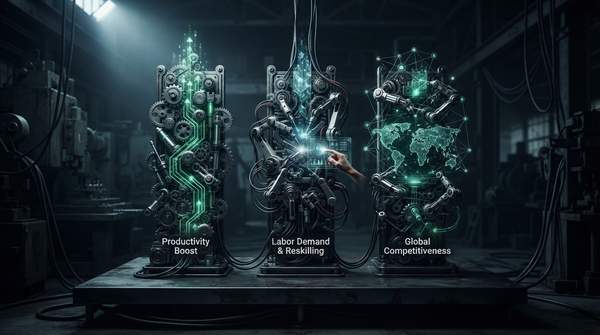
AI and robotics are transforming manufacturing economics through three interconnected channels: productivity gains that drive growth, a labor market that simultaneously displaces and creates work, and a reshaping of global competition and supply chains. Executives and policymakers who focus only on job displacement will misread the strategic picture. The evidence points to a more complex trade-off: the same technologies that threaten routine manufacturing roles also raise output per worker, shift hiring toward skills over credentials, and redraw the map of where industrial advantage sits.
Introduction: The Dual Impact of AI and Robotics in Manufacturing
The scale of the trend is easy to underestimate. Oxford Economics reported in its 2019 analysis that the global stock of robots in use had tripled over two decades to 2.25 million, and projected it could reach as many as 20 million by 2030, with 14 million in China alone. That forecast is a projection, not an observed outcome, but it signals the pace of capital deepening now underway in factories worldwide.
What makes this wave economically distinctive is the convergence of automation, energy storage, artificial intelligence and machine learning, which expands the range of tasks machines can take over. An academic analysis by Leshan Naisho, published in 2025, frames the core tension: AI offers the potential to increase productivity and drive economic growth, while also raising concerns about income inequality and job displacement. The influence extends beyond national borders into international trade, services and global supply chains. Understanding these effects as one system, rather than isolated headlines, is the first step toward sound strategy.