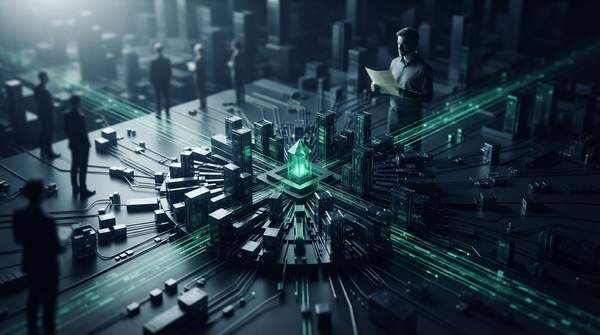
Here's the honest answer: economics offers two competing narratives about AI and work, and so far neither has been vindicated by the numbers. One story predicts displacement. The other predicts creation. Both are plausible. Both have history on their side, in different ways. But the empirical record—what researchers can actually measure in the US labor market today—shows little to no significant AI footprint on employment so far.
I find that gap between theory and data is the most useful thing a policymaker or business leader can understand right now. So let's walk through both stories, then check them against reality.
Introduction: The Dual Narratives of AI's Labor Impact
Ask an economist what AI will do to jobs and you'll get one of two stories. The first: AI automates tasks people used to do, and demand for those people falls. The second: AI makes workers more productive, spawns new products and services, and creates work nobody has imagined yet.
A policy brief from the Stanford Institute for Economic Policy Research, authored by economist Neale Mahoney, frames this as the central question of the moment: is AI fundamentally different from past technologies, or is it just the latest chapter in a very old pattern? Those who see AI as different point to its uniquely fast adoption, its disproportionate impact on cognitive work, and its cross-cutting reach—threatening not one occupation but much of white-collar work at once.
That framing matters. Because if AI is just another technology, history is a comforting guide. If it's not, history may mislead us. The honest position is that we don't yet know.
AI as a Displacement Force: The Luddite Fear Revisited
The displacement story has a loud modern messenger. Dario Amodei, CEO of Anthropic, has predicted that AI could wipe out half of white-collar jobs and push unemployment to 20 percent. That figure, reported in SIEPR's brief, is not fringe speculation—it comes from the head of one of the world's leading AI companies. A labor market upheaval of that magnitude, the brief notes, would cause enormous suffering for many households and pose a significant challenge for policymakers.
What makes this round of anxiety feel different is the target. Previous automation waves hit manual and routine work. AI, by its nature, is aimed at cognitive tasks—writing, analysis, code. The people at risk this time sit in offices, not factories.
But displacement fears have a history worth knowing. The Luddites feared that textile machinery would destroy their livelihoods. In one striking counterpoint from the historical record, the mechanized British textile industry at its peak a century later employed as many as 500,000 workers directly in spinning and weaving—and France employed more than two million, nearly 40 percent of its industrial workforce. Mechanization didn't kill textile employment. It eventually multiplied it. The disruption was real; the endpoint wasn't what the Luddites expected.
The early software evidence rhymes with that pattern. AI code generation has impacted mostly entry-level programmers, not senior developers. And because AI-generated code often contains errors, a new job category is emerging: software verification. The displacement happened—and it came with new work attached.
AI as a Creation Engine: New Roles and Enhanced Productivity
The creation story runs in the opposite direction. In this view, AI automates tasks but also enhances decision-making and generates new job opportunities in fields such as data analytics, machine learning, and AI development. The economist Michael Webb's research on AI and the labor market emphasizes a channel that displacement narratives often skip: AI may lead to the creation of entirely new products, which in turn shifts labor demand.
Timing, though, is the catch. Webb's analysis warns that we are too early in AI's development to know how much of the technology remains to be built or how long adoption will take. If history is a guide, the main impacts on the labor market may not appear for three decades. AI could diffuse faster than past technologies, since it doesn't require manually specifying its rules of operation. It could also be slower, given its vast data requirements and the need for complementary investments.
That's the creation story's quiet caveat. It may be right—and we might not see the evidence for a generation.
Comparing AI's Impact: Displacement vs. Creation
Here is the framework I use to keep the two narratives straight. The point of the table is not to pick a winner. It's to expose what each story assumes, so you can trace any prediction back to its mechanism.
| Economic Narrative | Core Mechanism | Predicted Outcome | Historical Parallel |
|---|---|---|---|
| AI as a Displacement Force | AI performs cognitive tasks previously done by humans, particularly white-collar work, reducing the need for those workers. | Large-scale job loss in white-collar occupations; Amodei's prediction of half of white-collar jobs eliminated and 20 percent unemployment. | The Luddite fear of textile machinery—though mechanized textiles ultimately employed hundreds of thousands more workers. |
| AI as a Creation Engine | AI enhances decision-making and productivity, and drives creation of new products, services, and job roles (e.g., data analytics, AI development, software verification). | Rising productivity, new job categories, and economic growth—with the main labor market impacts possibly arriving decades after the technology appears. | Slow-diffusing general-purpose technologies such as electricity, whose labor market effects unfolded over roughly three decades. |
The juxtaposition is the exercise. Notice that both narratives can be internally coherent and reach opposite conclusions, because they weight different mechanisms: substitution of human tasks versus creation of new demand. Displacement reasoning emphasizes the first. Creation reasoning emphasizes the second. Your prediction about AI's future labor market impact largely follows from which mechanism you believe dominates—and on what timeline.
The Reality Check: What the Data Shows So Far
Now the grounding. While the public debates AI's potential, research has been catching up. Two bodies of work deserve your attention, because they attempted to measure the AI footprint directly rather than project it.
Anthropic has published a task-based analysis of AI's labor market impact, combining theoretical AI capability with real-world usage. The Yale Budget Lab has examined whether the occupational mix is shifting in ways that track AI's introduction. The findings, as of the evidence reviewed here: limited evidence that AI has affected overall employment or the occupational mix to date. Measures of AI usage show no connection to changes in employment or unemployment. A differences-in-differences analysis of AI exposure does not yet clearly indicate an AI-related labor market footprint. Both analyses are planned for regular updates—which tells you researchers themselves expect the picture to move.
That last point is the one I'd underline. Absence of evidence today is not evidence of absence forever. The US-focused data may simply be too early, exactly as the creation narrative's slow-diffusion logic would predict.
Navigating AI's Evolution: A Call for Monitoring and Adaptation
My read: policymakers and business leaders should prioritize continuous monitoring of AI's real-world labor market impacts and invest in adaptive strategies like reskilling, rather than reacting to speculative predictions. Theories are cheap. Headline numbers from AI CEOs are not measurements. The measured record so far shows little effect—and plans built solely on a forecast of 20 percent unemployment, or on a guaranteed wave of new jobs, rest on assumptions the data hasn't confirmed.
The timing and distribution of AI's economy-wide effects depend heavily on the pace of firm adoption, and firms have an important role in minimizing displacement by reallocating tasks to leverage humans' comparative advantage alongside AI. That makes reskilling and upskilling programs crucial for adapting to an AI-driven economy—not as a hedge against a theory, but as the practical bridge between either outcome.
The measurable indicator to watch is concrete: ongoing reports from research bodies like Anthropic and the Yale Budget Lab on AI's labor market footprint, alongside the pace of firm adoption. When those regular updates start showing movement—occupational mix shifting in line with AI exposure, usage measures correlating with employment changes—that's when one of the two narratives begins earning its keep. Until then, keep both stories on the shelf, and watch the data.
Sources
- What is really happening to jobs? Separating AI hype from reality — Stanford Institute for Economic Policy Research (SIEPR)
- Michaelwebb
- CACM
- Iedconline