
All Stories

Choosing Between Patents and Trade Secrets: A Founder's Decision Framework for IP-Driven Valuation
Founders must strategically choose between patents and trade secrets based on technology type, defensibility, and funding stage to maximize IP-driven valuation and attract deep-tech investors. Aligning IP protection with the fundraising journey is crucial for success.

How AI Rebuilds the Firm: Centralization, Judgment, and the End of the Information Middleman
AI is fundamentally reshaping organizational structures by automating information processing, collapsing traditional hierarchies, and leading to centralization around executive judgment. Successful transition requires leaders to focus on workflow redesign, governance, and cultural change.

Network Effects and Market Concentration: A Diagnostic Framework for Digital Platforms
Digital platforms leverage direct, indirect, and data-driven network effects, creating feedback loops that can lead to market concentration and tipping. A diagnostic framework helps assess these effects and the risk of dominance, distinguishing durable competitive advantage from anti-competitive outcomes.

Agentic AI in Revenue Cycle Management: How It Moves Beyond Rules-Based Automation
Agentic AI in healthcare revenue cycle management (RCM) represents a significant shift from rule-based automation to autonomous systems capable of planning and executing complex workflows for financial outcomes. This advanced AI can adapt to changing conditions and exercise judgment, moving beyond the limitations of traditional automation to optimize RCM operations.

Eagle Security Solutions: The Role of Planning and Professional Experience in Executive Protection
In the complex world of personal and corporate security, proactive planning and seasoned experience are the cornerstones of effective executive protection. Eagle Security Solutions , a veteran-owned company serving Chesa…

Nearshoring vs. Reshoring: How to Run a Total Cost of Ownership Evaluation Before You Move Production
Evaluate nearshoring vs. reshoring decisions using a Total Cost of Ownership (TCO) framework that integrates quantitative costs like freight and tariffs with qualitative risks such as geopolitical stability, moving beyond simple labor cost comparisons.

Beyond the Chatbot: Three Ways Enterprises Are Actually Using Generative AI
Enterprises are moving beyond basic generative AI applications like content creation, focusing instead on three core patterns: automated data analysis, intelligent workflow automation, and specialized content/code generation. Successful deployments prioritize well-defined tasks, trusted data, and human oversight.

Four Ways to Diversify Critical Mineral Supply Chains—and What Each One Costs
The U.S. Department of Energy identifies four strategic pillars for diversifying critical mineral supply chains: diversifying foreign supplies, developing material alternatives, improving manufacturing efficiency, and investing in recycling and reuse. Each strategy offers distinct mechanisms, trade-offs in speed and cost, and varying exposure to geopolitical risks.

Startup PR by Stage: What to Prioritize at Pre-Seed, Seed, and Series A
Startup PR strategy must align with funding stages, prioritizing founder visibility at pre-seed/seed and product validation at Series A. Adapting tactics and budgets to each stage prevents common strategic missteps.

Eco-Friendly Auto Body Repair: How Fixing Minor Collision Damage Can Reduce Waste
Eco-friendly auto body repair prioritizes fixing minor collision damage to reduce waste, often by repairing existing components instead of replacing them. This approach also incorporates recycled and remanufactured parts, connecting cost savings with environmental benefits.

Two Paths to the Same Problem: How the UK and US Split on Fintech Regulation
The UK and US have adopted distinct strategies for regulating financial technology. The UK employs a centralized, proactive, principles-based model with regulatory sandboxes, while the US utilizes a fragmented, rules-based framework that is now being streamlined to foster innovation.

How Real-World Assets Get Onto a Blockchain: The Three-Layer Stack Behind RWA Tokenization
Tokenizing real-world assets involves a three-layer stack: off-chain legal ownership, an integration data bridge, and on-chain smart contracts. Understanding this architecture, particularly the foundational off-chain layer where many projects fail, is crucial for successful RWA tokenization and its benefits like liquidity and transparency.

AI in Customs: Where Fraud Detection Meets the Digital Divide
Customs agencies are increasingly adopting AI for fraud detection and cargo inspection to balance trade facilitation with supervision and reduce corruption. However, global adoption is uneven due to significant disparities in digital readiness, infrastructure, and skills, creating a digital divide.

SAFE or Convertible Note? A Founder's Decision Framework for Early-Stage Funding
Founders deciding between SAFEs and Convertible Notes for early-stage funding can use a decision framework based on speed, investor preference, round size, and debt tolerance. While SAFEs offer simplicity and speed, Convertible Notes provide structure preferred by some investors or for larger rounds.

How GLB Financial Services Simplifies SGLI Conversion for Veterans (2026 Ultimate Guide)
GLB Financial Services offers an ultimate guide for veterans on simplifying Servicemembers' Group Life Insurance (SGLI) conversion, a crucial financial decision post-military service. The guide details how SGLI conversion works, veterans' options, and the critical 120-day deadline.

How Governments and Pension Funds Structure Venture Capital: Three Models, Two Objectives
Governments and pension funds face a choice when investing in venture capital: prioritize financial returns, policy goals, or a combination. This article explores three distinct models—fund-of-funds, direct/corporate venturing, and cornerstone investor—and how each balances these objectives based on the sponsor's strategic priorities.

Quantum Computing and Financial Risk: Why Monte Carlo Is the First Model in the Crosshairs
Quantum computing is poised to enhance financial risk assessment, especially Monte Carlo simulations, by offering potential quadratic speed-ups, though current hardware limitations necessitate a focus on preparation and benchmarking.

Synthetic Data Doesn't End Your GDPR and CCPA Obligations — It Changes Where They Apply
Synthetic data generation, while reducing privacy risks, does not eliminate GDPR and CCPA obligations. Compliance duties are triggered during the generation phase when real personal data is used, requiring lawful basis, PIAs, and ongoing due diligence.

Five Job Categories Built on Skills AI Still Can't Copy
This article identifies five job categories that are resilient to AI automation, focusing on uniquely human skills like empathy, creativity, and judgment. It provides a framework for evaluating career paths based on these durable human capabilities.

How I Use Vincere Portfolios for Hands-Off Futures Trading While Working a Full-Time Job
The author, a professional with a demanding career, found a truly automated, institutional-grade solution with Vincere Portfolios for hands-off futures trading. This system allows them to build wealth without needing constant attention, focusing on regulated markets and sophisticated risk management.
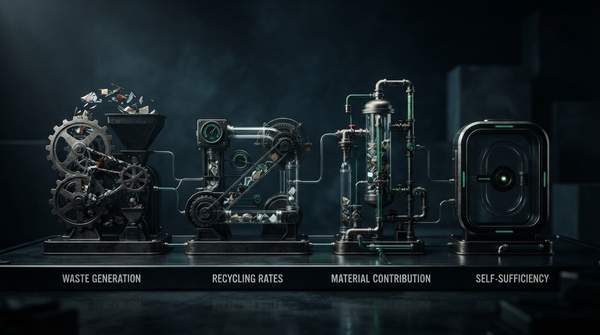
Four Circularity Metrics, Four Different Stories: How to Read the EU's Core Indicators Without Being Fooled
The EU tracks four key circularity metrics—waste generation, recycling rates, recycled material contribution, and self-sufficiency—each offering a distinct perspective with its own limitations. Understanding these differences is crucial for accurately assessing circularity and avoiding misinterpretations in policy, investment, and reporting.

Mapping Behavioral Economics to Startup Growth: A Founder's Decision Framework
Founders can leverage behavioral economics principles to overcome common startup growth challenges such as pricing, conversion, and retention. This article provides a framework mapping specific problems to psychological triggers and offers ethical application strategies for sustainable growth.

Choosing a Startup Valuation Method: Match the Method to Your Stage and Your Data
Early-stage founders should select startup valuation methods that align with their company's current stage and the quality of available data. This guide explains the Berkus, Scorecard, and Venture Capital methods, offering a decision matrix to help choose the most appropriate approach for pre-seed to Series A companies.

Four Criteria That Separate Promising Emerging Markets From Risky Ones
Emerging markets offer unique diversification benefits, but investors must carefully evaluate them using four key criteria: macroeconomic stability, political and regulatory environment, ESG profile, and market liquidity. Understanding the inherent trade-offs between growth potential and volatility is crucial for informed investment decisions.